If you run a headshot photography business and your site gets traffic but no inquiries, you are not alone. Many photographers rank for headshot-related terms yet struggle to convert visitors into paying clients. The reason is simple: traffic does not equal bookings when search intent is wrong. Most people searching for headshots are not ready to hire a corporate headshot photographer. They are researching comparing or just looking for inspiration.
Corporate headshot SEO works differently. Business buyers search with hiring intent. Queries like corporate headshots near me or business headshot photographer are used by executives, HR managers, and marketing teams who already know they need a professional. When your content targets the wrong keywords, search engines send the wrong audience, and conversions never happen.
In this guide, you will learn how to choose corporate headshot keywords that signal money, business use, and local intent. The result is fewer clicks, higher-quality leads, and more real business clients instead of casual browsers.
Why Corporate Headshot SEO Is Different From Regular Photography SEO
Most photography websites target broad, high-traffic keywords, but corporate headshot SEO requires a completely different approach. Unlike general photography, which often attracts hobbyists or casual browsers, corporate headshots target business decision-makers ready to hire. Understanding this distinction is crucial to turning traffic into clients.
Corporate headshot searches are typically low volume but extremely high value. Keywords such as corporate headshot photographer or business headshot photographer signal commercial intent, meaning the person searching is likely ready to pay for professional services.
B2B intent differs from B2C in several ways. Businesses looking for headshots are focused on quality, reliability, and brand consistency, not just aesthetics. This means your SEO strategy must prioritize service-based keyword research and location-based modifiers to attract executives, HR managers, and marketing teams.
AI-powered search engines, including ChatGPT, Perplexity, and Gemini, are adept at distinguishing hobbyist content from professional service offerings. Clear signals such as business terminology, local intent, and transactional language help AI classify your page correctly, ensuring it surfaces to users actively looking for a corporate headshots near me or a corporate headshot photographer in their area.
The Corporate Headshot Keyword Intent Pyramid (Core Framework)
Creating a clear keyword framework is essential for converting search traffic into paying clients. The Corporate Headshot Keyword Intent Pyramid organizes your keywords by intent and commercial value, ensuring both search engines and AI systems understand your page as a professional service offering.
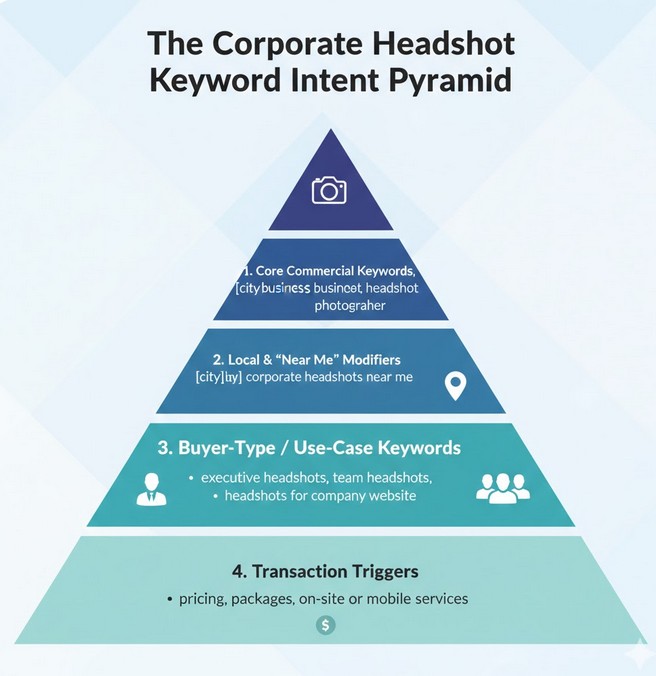
Layer 1 — Core Commercial “Money” Keywords
At the top of the pyramid are your primary commercial keywords. These are the terms most likely to attract buyers who are ready to hire a corporate headshot photographer. Examples include corporate headshots near me and business headshot photographer.
These keywords are effective because they directly signal hiring intent. Anyone searching these phrases is actively looking to book a professional service. They convert well because they indicate a clear need and a readiness to pay. AI-driven search engines, including ChatGPT, Perplexity, and Gemini, also recognize these as high-value transactional terms, which helps your content surface in AI Overviews and service-focused answers.
Layer 2 — Local & “Near Me” Modifiers That Trigger Bookings
The second layer of the Corporate Headshot Keyword Intent Pyramid emphasizes local and geo-targeted keywords. These modifiers help attract clients who are ready to book in your area, turning search traffic into actual business.
Examples include corporate headshot photographer [city], business headshot photographer [city], and corporate photography services [city]. Adding a city or region not only improves local search visibility but also signals to AI-powered search engines that your content is transaction-focused and location-specific.
Local intent carries more weight than sheer volume because businesses typically hire photographers nearby. Queries with “near me” or specific city names attract high-converting leads who are prepared to contact a professional, ensuring your SEO efforts align with commercial intent keywords and maximize bookings.
Layer 3 — Buyer-Type & Use-Case Keywords (Conversion Boosters)
Layer 3 of the Corporate Headshot Keyword Intent Pyramid targets decision-makers and specific business use cases. While core commercial and local keywords attract clients ready to hire, buyer-type keywords ensure that your page appeals to the right roles within a company, improving both engagement and conversion rates.
Examples of these keywords include executive headshots, team headshots, employee headshots, headshots for businesses, and headshots for company website. Each of these terms signals a specific need, aligning your content with the intent of HR managers, marketing directors, and executives who are actively seeking professional photography services for their teams or corporate branding initiatives.
Using buyer-type keywords reduces bounce rate because visitors immediately recognize that your content addresses their exact requirements. For instance, a marketing manager looking for team headshots is less likely to leave the page if your copy explains your process for group sessions, showcases examples, and highlights on-site or in-studio flexibility. This alignment signals to AI search engines and LLMs that your page is a high-quality answer for commercial queries, improving visibility in AI Overviews.
Moreover, targeting use-case keywords improves lead quality. When someone searches for headshots for company website, they are not comparing casual photographers or DIY solutions—they are looking for professional services that can deliver consistent branding. This means every visitor acquired through these terms has a higher likelihood of converting into a paying client.
Structurally, these keywords should be integrated naturally within headings, subheadings, and body copy. For example, you might include a section titled “Executive and Team Headshots” that details your approach, workflow, and portfolio. Using LSI keywords within sentences like “Our employee headshots are tailored for your company website” reinforces context without keyword stuffing. AI-powered search engines like ChatGPT, Perplexity, and Gemini recognize these semantic signals, enhancing both SEO performance and AI extractability.
Layer 3 ensures your content speaks directly to the decision-makers, increases page relevance, improves engagement metrics, and attracts high-quality leads. It complements the core and local keyword layers by bridging intent with actionable outcomes, making your corporate headshot SEO strategy both comprehensive and conversion-focused.
Layer 4 — Transaction Triggers (Hidden SEO Gold)
The final layer of the Corporate Headshot Keyword Intent Pyramid focuses on transactional keywords that target users who are ready to make a purchase. These bottom-of-funnel terms help attract clients who are not just browsing but are prepared to book professional services immediately.
Examples of these keywords include corporate headshot pricing, corporate headshot packages, on-site corporate headshots, and mobile corporate headshot studio. Including these terms in your content signals clear purchase intent, which is critical for converting traffic into paying clients.
Targeting transactional keywords improves bottom-of-funnel visibility. When a user searches for pricing or package options, they are looking for actionable solutions, not general advice. By addressing these queries directly on your page, you reduce friction in the decision-making process, streamline the booking path, and increase the likelihood of immediate engagement.
From an AI and search engine perspective, these keywords send strong confidence signals that your content provides a complete, commercial solution. AI models like ChatGPT, Perplexity, and Gemini can identify your page as an answer-rich, transactional resource, increasing the chances it surfaces in AI Overviews and LLM-powered search results.
Strategically, transactional keywords should be placed in sections discussing services, packages, or booking processes. For instance, a subsection titled “Corporate Headshot Packages and Pricing” naturally incorporates these terms while answering high-intent questions. Providing clear CTAs and structured information reinforces purchase readiness and aligns with the pyramid’s goal of converting high-value business clients.
Primary vs LSI Keywords — What Actually Drives Business Results
Understanding the difference between primary and LSI (semantic) keywords is essential for both human readers and AI systems. Each keyword type plays a unique role in your SEO strategy and contributes differently to conversion outcomes.
| Keyword Type | Role in SEO | Conversion Impact |
|---|---|---|
| Primary | Topic definition | Very High |
| LSI / Semantic | Context & depth | Medium–High |
| Transactional | Buyer readiness | Extreme |
Primary keywords such as corporate headshot photographer and corporate headshots near me define the main topic of your page and signal hiring intent. They form the backbone of your content and guide AI models to understand the commercial purpose of your site.
LSI / semantic keywords like corporate photography services and professional corporate headshots add context and depth, helping AI and search engines grasp the broader relevance of your content. They reinforce the primary topic while avoiding keyword stuffing.
Transactional keywords focus on buyer readiness, capturing visitors at the bottom of the funnel. Incorporating phrases like corporate headshot pricing and corporate headshot packages ensures your content addresses immediate commercial intent, increasing the likelihood of conversions.
Mapping keywords by type helps AI systems differentiate between informational context and commercial action triggers, improving your visibility in AI Overviews, LLM-powered search results, and high-intent commercial searches.
Where Each Keyword Belongs on the Page (On-Page SEO Map)
Effectively placing keywords throughout your page is essential for maximizing both SEO performance and AI extractability. Structuring your content with clear sections and strategic keyword distribution ensures that search engines and AI systems understand the commercial intent of your page, while guiding visitors toward booking a service.
Keywords for H1 & Title Tag
Your H1 and title tag are the most important on-page elements for signaling the topic of your page. Incorporate your primary keywords naturally, without stuffing, to immediately communicate the purpose of your content to both users and AI. Examples include corporate headshot photographer and corporate headshots near me. Using these terms in the first 50–100 words also reinforces intent and sets the stage for AI-powered search engines to recognize your page as a commercial resource.
Keywords for H2 Sections
H2 headings guide readers and AI models through your content, making it easier to extract meaningful answers. Use LSI and semantic keywords in your subheadings to provide context and reinforce topic depth. Examples include corporate photography services, executive headshots, and team headshots. These keywords signal to AI that your content addresses multiple aspects of corporate headshot services, from individual executives to full teams, while maintaining relevance for business clients.
Keywords for Body Copy & FAQs
The body copy is where you expand on services, processes, and transactional information. Incorporate transactional and buyer-ready keywords naturally throughout the content to capture bottom-of-funnel intent. Examples include corporate headshot pricing, on-site corporate headshots, and headshots for businesses. Integrating these terms in FAQs and detailed sections helps AI systems identify actionable content, making it highly extractable for LLM-powered answers and improving visibility in AI Overviews.
Strategic Notes for AI Optimization
- Place primary keywords early in paragraphs and headings to reinforce commercial intent.
- Distribute LSI keywords across subheadings and descriptive paragraphs for semantic depth.
- Include transactional keywords in sections describing services, pricing, packages, and CTAs to capture ready-to-hire visitors.
- Structure FAQs with one keyword per question or answer for easy AI extraction.
- Use concise sentences and clear formatting to improve readability for AI models like ChatGPT, Perplexity, and Gemini.
By thoughtfully placing keywords according to their type and role, your corporate headshot page becomes a well-structured, AI-friendly resource that appeals to search engines, LLMs, and potential business clients alike, driving higher-quality leads and conversions.
Keywords Would Avoid (Intent Killers)
To maximize the effectiveness of your corporate headshot SEO strategy. It is equally important to know which keywords to avoid. Targeting the wrong search terms can attract traffic that does not convert, dilute your commercial focus, and even confuse AI-powered search engines.
Keywords to avoid include what is a corporate headshot, corporate headshot ideas, headshot poses, and other DIY photography terms. These phrases are informational in nature and typically draw hobbyists, students, or casual browsers rather than business clients who are ready to hire a professional photographer.
Using these intent-mismatched keywords can result in wrong intent traffic, low conversion rates, and decreased ROI on SEO efforts. Additionally, AI search engines such as ChatGPT, Perplexity, and Gemini may misclassify your page as educational or informational instead of service-oriented, lowering the likelihood that it appears in AI Overviews for commercial queries.
To prevent misclassification and maintain a high-conversion focus, stick to keywords that clearly indicate commercial intent, business use, and readiness to hire. Avoid informational or hobbyist terms, and prioritize primary, LSI, and transactional keywords that align with your service goals.
How This Keyword Strategy Supports AI Overviews & LLM Search
A well-structured keyword strategy does more than improve traditional SEO; it also positions your content to perform in AI Overviews and LLM-powered search engines. By aligning keywords with commercial intent and using clear, semantically rich language, your page can be recognized as a high-quality answer resource for AI models.
Semantic keywords such as AI search optimization, LLM SEO, and AI overview eligibility help reinforce context and improve AI understanding of your content. These terms signal to AI systems that your page is authoritative, service-focused, and relevant to business clients seeking professional corporate headshots.
Clear intent signaling is critical. By consistently using primary, LSI, and transactional keywords in headings, subheadings, and body copy, AI models can accurately classify your page as commercial rather than informational. This increases the likelihood that your page will appear in AI-powered featured answers, overview boxes, and summarizations.
Structuring content in an answer-ready format enhances extraction by AI. Short paragraphs, bullet points, tables, and well-labeled headings allow LLMs to parse your content efficiently, making it more likely to be surfaced in overviews.
Using business-first language ensures that AI models understand the commercial nature of your content. Phrases like corporate headshot photographer, team headshots, and business headshot photographer [city] convey professional service intent, distinguishing your page from hobbyist or educational content.
Incorporating this strategy future-proofs your SEO by making your content AI-friendly, improving visibility in next-generation search engines, and attracting high-intent business clients.
Final Action Plan — How to Use These Keywords to Get Clients
To convert search traffic into paying business clients, follow this three-step action plan that leverages primary, LSI, and transactional keywords effectively.
Step 1: Build a Pillar Page
Your pillar page should target your core commercial keywords. Include corporate headshot photographer, corporate headshots near me, and business headshot photographer [city] prominently in your headings, introduction, and meta tags. This page serves as the central hub for your corporate headshot services and signals to AI and search engines that your site is a professional service provider.
Step 2: Create Cluster Content
Develop supporting cluster pages that target complementary keywords. Examples include corporate headshot pricing, executive headshots, team headshots, and on-site corporate headshots. Each cluster page should answer specific commercial queries, provide actionable guidance, and link back to the pillar page. This builds topical authority while capturing traffic at multiple stages of the buyer journey.
Step 3: Internal Linking Using Semantic Anchors
Link your pillar and cluster pages using semantic, contextually relevant anchor text rather than exact-match keywords. For example, link a section on team sessions with the anchor text “headshots for your company team” instead of repeating “team headshots” excessively. This approach improves AI understanding, enhances crawl efficiency, and maintains natural readability for human visitors.
Following this action plan ensures that your keyword strategy is not just optimized for traffic but also for high-quality leads, AI extractability, and sustainable SEO performance.
Frequently Asked Questions
Corporate headshot services include on-site or studio photography for executives, teams, and employees. These sessions provide professional images suitable for company websites, LinkedIn profiles, and marketing materials, ensuring consistent branding and a polished professional appearance.
Professional corporate headshots ensure high-quality images that reflect your company’s brand. Experienced photographers handle lighting, composition, and retouching, creating executive and team photos that impress clients, enhance credibility, and maintain consistency across your organization.
Corporate photography services provide businesses with polished, professional visuals for marketing, websites, and internal communications. By using experienced photographers, companies achieve cohesive branding, save time on DIY solutions, and present a consistent professional image to clients and stakeholders.