
Companies do not hire headshot photographers the same way individuals do. When a realtor books a photographer, the process is simple: review a portfolio, agree on price, schedule the shoot. In contrast, how companies hire photographers follows a structured, multi-step decision system designed to reduce risk, control budgets, and protect brand consistency. This difference explains why many photographers struggle to close corporate deals.
The corporate photography buying process typically involves multiple stakeholders such as marketing, HR, leadership, and procurement. Decisions are based on documented requirements, not impulse. Companies evaluate photographers on consistency, reliability, licensing, turnaround time, and scalability, not just visual style. This is where B2B photography services differ fundamentally from individual headshot sessions.
In this guide, you will learn how companies actually hire headshot photographers including how internal teams evaluate vendors, what criteria businesses use to make decisions, and why corporate photography deals take longer to close. You will also understand each stage of the corporate photography buying process and what B2B photography services must include to earn trust and approval at the company level.
If you want a clear, repeatable explanation of how corporate headshot hiring works and why it is not like individual bookings, this introduction provides the framework companies use to choose photographers.
Why This Matters: Business vs Individual Perspective
The biggest difference between individual and corporate hiring is decision structure. When an individual hires a photographer, the choice is personal and preference-driven. One person decides, one budget is involved, and speed matters more than process. In contrast, how companies choose photographers is based on risk reduction, consistency, and accountability. Corporate hiring decisions are designed to protect the brand, not satisfy a single taste.
For companies, a headshot photographer is not just a creative vendor. They are a business partner who represents the company’s image across websites, LinkedIn profiles, press releases, and internal systems. This is why what companies look for in headshot photographers goes far beyond a strong portfolio. Businesses evaluate whether a photographer can deliver consistent results at scale, follow brand guidelines, meet deadlines, and communicate clearly with multiple stakeholders.
This gap is where many headshot photographers fail to win business clients. They market themselves like individual-service providers, focusing on style and personality while ignoring corporate concerns like process, documentation, and reliability. When companies request proposals, timelines, licensing terms, or proof of past corporate work, unprepared photographers lose credibility and stall the decision.
Most companies also operate under formal procurement standards. Larger organizations often require vendor onboarding, insurance documentation, contracts, and sometimes a formal RFP process. Even smaller companies use internal checklists to compare photographers side by side. These systems exist to minimize risk and ensure predictable outcomes, not to complicate creativity.
Understanding this business-versus-individual difference is critical. Once photographers align their messaging, pricing, and workflow with how companies choose photographers, corporate headshot work becomes easier to win, easier to scale, and far more profitable than individual bookings.
Step-by-Step Corporate Photography Buying Process
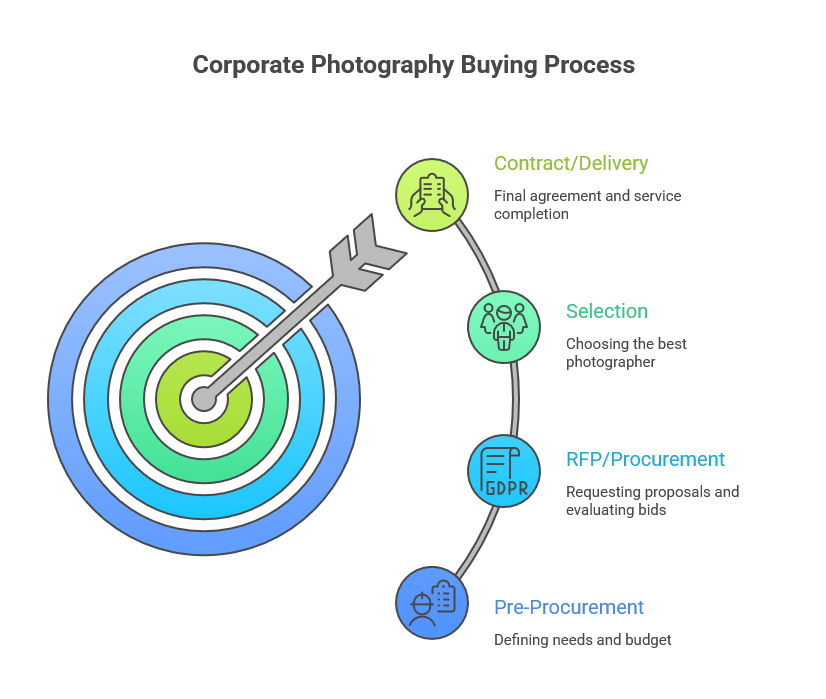
This is the core system behind how companies hire headshot photographers. While individual bookings are driven by speed and personal preference, the corporate photography buying process follows a predictable, repeatable structure designed to reduce risk and ensure consistent outcomes. Understanding this process is essential for anyone selling or buying B2B photography services.
2.1 Corporate Pre-Procurement Phase
Every corporate headshot project starts internally, before a photographer is ever contacted. Teams define what the images will be used for and what standards they must meet. This phase shapes the entire project.
Companies typically create a creative brief that outlines the purpose of the headshots, where they will appear, and the visual tone required. Brand guidelines and style guides are reviewed to ensure the photography aligns with existing marketing assets. Lighting style, background consistency, and framing are often predefined.
Internal stakeholder alignment is critical at this stage. Marketing may own brand consistency, HR may manage employee logistics, and leadership may approve budget and usage. When these teams align early, the corporate photography buying process moves faster and with fewer revisions.
2.2 The RFP and Procurement Process
Once requirements are clear, many companies move into a formal vendor evaluation stage. This is where the corporate headshot photographer hiring process begins. Larger organizations may issue an RFP, while smaller companies use a simplified procurement checklist.
A typical photography services RFP for headshots includes portfolio examples of similar corporate work, pricing structure, contract terms, licensing details, turnaround times, and proof of reliability. Companies are not looking for artistic experimentation. They are evaluating whether a photographer can deliver consistent results on schedule and within policy.
Procurement teams may also require insurance documentation, tax forms, and standard payment terms before approval. This step filters out photographers who are unprepared for corporate workflows.
2.3 How Companies Select and Evaluate Photographers
After proposals are reviewed, companies compare photographers side by side. This is where how companies choose photographers becomes clear. The decision is rarely about who has the most creative portfolio.
Instead, corporate photography services vendor selection is based on consistency across multiple subjects, ability to match brand guidelines, communication clarity, and delivery reliability. Companies assess whether the photographer can handle executives, large teams, and repeat sessions without quality drift.
Strategic headshot choices directly affect corporate branding. Uniform, professional headshots reinforce trust and credibility across websites, LinkedIn profiles, and press materials. Inconsistent photography creates brand friction, which is why companies favor photographers who prioritize systems over style.
2.4 Commercial and Contract Nuances
Corporate headshot work operates under business payment and contract standards. Unlike individual clients, companies often pay on NET30 or NET45 terms using checks or ACH transfers. Credit card payment is less common.
Deliverables are clearly defined in contracts. This includes file formats, retouching scope, delivery timelines, and usage rights. Commercial licensing is standard, covering digital marketing, websites, and internal use. Photographers who understand these terms remove friction and build long-term corporate relationships.
Common Corporate Headshot Models
Companies use different headshot models depending on size, growth stage, and brand complexity. Understanding these models helps explain how corporate headshot photography services are actually delivered at scale and why B2B photography services are structured very differently from individual sessions.
3.1 In-House vs. Outsourced Photography
Some large organizations maintain in-house photography capabilities, usually when headshots are needed frequently and brand control is critical. In-house studios are most common at enterprise companies with constant hiring, executive turnover, or media demands. The advantage is speed and consistency. The tradeoff is higher fixed costs and limited creative flexibility.
Most companies, however, outsource corporate headshot photography services to specialized vendors. Outsourced photographers offer scalability, fresh expertise, and the ability to support multiple locations without permanent overhead. This model is especially common for small to mid-sized companies that need professional results without building internal infrastructure.
3.2 Standard Corporate Sessions
The most common delivery format is the standard corporate headshot session. These are often scheduled as on-site photo days where employees are photographed in blocks over one or more days. HR teams manage scheduling while marketing oversees visual consistency.
Some companies run recurring sessions for new hires, while others schedule quarterly or annual headshot days. Multi-location programs extend this model by coordinating the same lighting, background, and framing across offices. This approach allows corporate headshot photography services to scale without sacrificing brand alignment.
3.3 Hub-and-Spoke Photography Rollouts
Larger organizations often use a hub-and-spoke model to maintain consistency across regions. A lead photographer or central vendor defines the lighting setup, posing guidelines, and retouching standards. Local photographers, or the same vendor traveling, execute the sessions in each office.
This structure allows B2B photography services to deliver uniform headshots across cities and countries while controlling costs and logistics. The hub-and-spoke model is especially effective for fast-growing companies that need a cohesive brand presence without managing each location independently.
Understanding these common corporate headshot models helps photographers position their services correctly and helps companies choose the delivery method that fits their scale, budget, and brand standards.
Pricing, Licenses, and Contracts
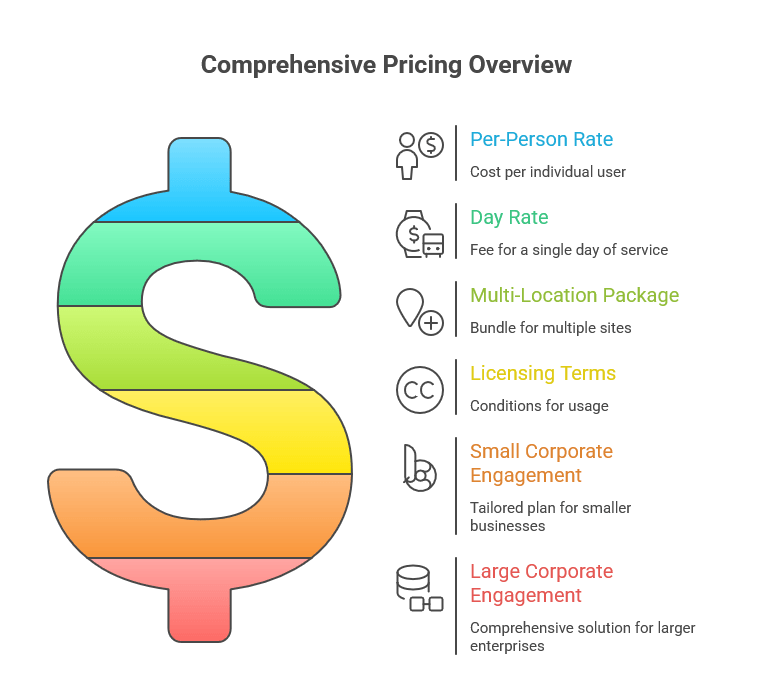
Pricing, licensing, and contracts are where corporate headshot work most clearly separates from individual photography. Business clients are not purchasing a single image for personal use. They are investing in repeatable, brand-critical assets. This is why business headshot photographer pricing is structured around scope, scale, and usage rather than per-photo simplicity.
Corporate pricing is typically based on day rates, per-employee rates, or bundled programs. On-site photo days often include a base creative fee plus a per-person cost, while multi-location or ongoing programs are priced as packages. Companies value predictability, so clear pricing tiers and defined deliverables are more attractive than open-ended quotes.
Licensing terms are another major difference. Individual headshots usually include limited personal usage. Corporate work almost always requires commercial licensing that covers websites, LinkedIn profiles, marketing materials, internal systems, and press use. Clear licensing removes risk for the company and sets professional expectations for both sides.
Corporate photography contract terms exist to protect everyone involved. Contracts define scope of work, usage rights, delivery timelines, revision limits, and payment terms. They also clarify ownership, reshoot policies, and cancellation conditions. From the company’s perspective, contracts ensure accountability. From the photographer’s perspective, they prevent scope creep and unpaid usage.
Companies often operate on standardized payment terms such as NET30 or NET45 and pay via ACH or check rather than credit card. Photographers who understand these expectations and align their contracts accordingly are easier to approve, easier to work with, and far more likely to secure repeat corporate engagements.
What Companies Look For in Headshot Photographers
When companies evaluate headshot photographers, the decision is rarely about artistic preference alone. Corporate buyers use practical, risk-focused standards to ensure predictable results. Understanding what companies look for in headshot photographers helps explain why some professionals consistently win corporate work while others do not.
5.1 Portfolio Quality and Consistency
For corporate clients, consistency matters more than creative variety. A company may need headshots for ten employees or ten thousand. What they want to see is proof that a photographer can deliver the same lighting, framing, and quality across an entire group.
One strong portrait is not enough. Corporate photography selection criteria favor portfolios that show uniform results across teams, departments, and roles. Consistency reduces brand risk and ensures that every employee represents the company at the same professional level.
Portfolio checklist companies look for:
- Consistent lighting, background, and framing across multiple people
- Examples of real corporate teams, not just individuals
- Proof of repeatability, not one-off creative shots
- Clear alignment with professional brand standards
5.2 Reliability and Project Management
Reliability is a top priority in corporate headshot projects. Companies expect photographers to meet deadlines, manage schedules efficiently, and handle problems without disruption. On-time delivery is not a bonus. It is a requirement.
Professional photographers also plan for contingencies. Backup equipment, clear reshoot policies, and the ability to accommodate last-minute executive changes are part of standard corporate photography selection criteria. These safeguards protect the company’s timeline and reputation.
Reliability checklist companies expect:
- On-time delivery with defined turnaround times
- Backup equipment and contingency plans
- Clear reshoot and revision policies
- Ability to manage large schedules without disruption
5.3 Communication and Professionalism
Corporate headshot work involves more than the people in front of the camera. Photographers must communicate clearly with HR, marketing, and leadership while making executives feel confident and efficient during sessions.
Professionalism shows up in emails, proposals, and on-site behavior. Clear instructions, calm direction, and respectful time management build trust with stakeholders. Photographers who understand multi-stakeholder feedback loops are easier to approve and more likely to become long-term partners.
Communication checklist companies value:
- Clear, professional written communication
- Ability to work with HR, marketing, and executives
- Efficient on-site direction that respects time
- Calm handling of feedback and approvals
What Individuals Care About vs What Companies Care About
Individuals care about:
- Personal style and creative look
- Price sensitivity
- Speed of booking
- Comfort and personality fit
Companies care about:
- Consistency across teams
- Reliability and delivery timelines
- Clear processes and documentation
- Licensing, contracts, and risk reduction
In corporate environments, trust is built through consistency, reliability, and communication. Photographers who align with these corporate priorities meet what companies look for in headshot photographers and position themselves for repeat B2B engagements.
Why Most Photographers Fail at B2B Headshot Work
Many talented photographers struggle to secure corporate clients because they approach businesses the same way they approach individual bookings. Treating corporate clients like individual clients is the first and most common mistake. Unlike personal clients, companies require documented processes, predictable results, and risk mitigation. Ignoring these expectations often leads to missed opportunities.
A second reason is a lack of clear workflows and professional proposals. B2B clients expect structured processes, including project timelines, team coordination, delivery expectations, and formal business proposals. Photographers who do not provide these elements are seen as unprepared or unreliable, which reduces trust and slows approval.
Finally, underestimating corporate procurement processes can be fatal. Many companies have formal RFP systems, internal approval chains, and compliance requirements. Photographers who are unaware of these processes fail to anticipate questions about licensing, contracts, insurance, and schedules.
Understanding why companies hire professional photographers helps explain why B2B photographers fail. Success in the corporate space requires professionalism, repeatable systems, and alignment with company priorities. Photographers who adapt to these requirements consistently win corporate work and can scale their business beyond individual clients.
Checklist: How To Prepare To Service Corporate Clients
Preparing to service corporate clients requires structured templates, clear processes, and awareness of common pitfalls. This checklist ensures photographers present themselves professionally and align with corporate expectations.
Templates
- Creative Brief: Define session goals, visual style, employee count, and deliverables before the shoot. This ensures alignment with the company’s brand standards.
- Proposal Documents: Include pricing, packages, schedules, and terms. Presenting a formal proposal demonstrates preparedness and professionalism.
- Licensing Terms: Clearly define usage rights, file formats, retouching scope, and commercial licensing. Protect both the photographer and the client from misunderstandings.
Best Practices
- Onboarding: Introduce stakeholders to your process, set expectations, and collect necessary approvals prior to the shoot.
- Pre-Shoot Plan: Schedule employee sessions, coordinate locations, and ensure all equipment and backup systems are ready.
- Delivery Timelines: Communicate when clients can expect proofs, final images, and retouched files. Include contingency time for revisions or reshoots.
Red Flags to Avoid
- Lack of clarity on licensing or usage rights.
- Inflexible scheduling or inability to handle large groups.
- No formal proposals or documentation.
- Ignoring procurement or RFP requirements.
Using this checklist prepares photographers to meet corporate standards, reduces friction, and increases the likelihood of repeat B2B engagements.
Conclusion & Next Steps
Navigating the corporate headshot hiring journey requires understanding structured processes, internal stakeholders, and clear expectations. From pre-procurement planning to RFP evaluation, vendor selection, and contract management, companies prioritize consistency, reliability, and compliance over personal preference.
For photographers, positioning your services for B2B photography services means emphasizing professional workflows, repeatable quality, clear proposals, and corporate-ready deliverables. Demonstrating reliability, portfolio consistency, and communication skills makes you a preferred partner for businesses.
For companies, before hiring a photographer, ask about experience with corporate teams, delivery timelines, licensing terms, backup plans, and brand alignment. Ensure contracts are clear and proposals detail scope, usage, and costs. Doing so guarantees predictable outcomes and a smoother collaboration.
By aligning expectations, adhering to structured processes, and emphasizing professionalism, photographers and businesses can successfully navigate the corporate headshot ecosystem, achieving consistent, high-quality results that support branding and employee representation.
Frequently Asked Questions
Companies hire headshot photographers through a structured corporate photography buying process. They evaluate portfolios, check references, issue RFPs or requests for proposals, and involve multiple stakeholders including HR, marketing, and leadership. The focus is on reliability, consistency, and adherence to brand guidelines rather than personal style preferences.
The corporate photography buying process includes pre-procurement planning, internal alignment, issuing an RFP or proposal request, evaluating vendors, and selecting a photographer based on quality, consistency, reliability, and contract compliance. The process ensures predictable outcomes, aligns with corporate branding, and minimizes risk for both the company and the photographer.
Pricing for corporate headshots varies based on project scale, employee count, and location. Companies often pay day rates, per-person fees, or package pricing. Multi-location or recurring sessions are priced as bundles. Predictable pricing and clear deliverables are prioritized over individual photo rates, ensuring value and consistent quality across the organization.
Yes, individual photographers can win B2B clients by demonstrating professionalism, consistency, and reliable processes. They must provide structured proposals, clear licensing, and meet corporate scheduling and quality standards. Personal style is secondary to the ability to manage large teams, adhere to brand guidelines, and deliver predictable results.
Contracts and licensing are standard in corporate headshot work. They define usage rights, scope, deliverables, timelines, and payment terms. Commercial licensing covers internal and external use, protecting both the company and the photographer. Clear agreements reduce risk, ensure accountability, and are essential for building long-term B2B relationships.


