
If you’re a photographer struggling to get consistent clients, chances are you’ve already tried running ads, posting on Instagram, or joining yet another Facebook group.
But what if I told you there’s a simpler, faster, and almost zero-cost way to build a steady pipeline of new clients without spending a cent on ads?
That strategy?
Partnering with local businesses.
When you collaborate with local shops, cafes, event planners, or brands in your city. You tap into their existing audience. An audience that already trusts them.
Whether you’re a wedding photographer teaming up with florists, a portrait photographer working with salons, or a food photographer collaborating with restaurants. These partnerships can create a steady stream of referrals and exposure.
In this guide, I’ll break down the exact 10-step system to help you form profitable photography partnerships. The same framework I’ve seen photographers use to triple their bookings within three months.
You’ll get:
- Proven outreach scripts (7 email templates you can copy)
- Partnership contract examples
- Real case studies and examples
- A ready-to-use workflow to manage collaborations
This isn’t theory — it’s practical, tested, and easy to replicate.
Let’s dive in.
Step 1: Understand Why Partnerships Beat Paid Ads
Most photographers treat marketing like a slot machine. They throw in money, hope for leads.
The problem? Ads are expensive, unpredictable, and short-term.
Local partnerships, on the other hand, create compounding growth. When a trusted business recommends you, their customers listen. It’s free word-of-mouth, amplified by shared visibility.
Here’s why partnerships outperform ads:
- Built-in trust: Customers are 4x more likely to buy from a referral source they already trust.
- Shared audiences: You get instant exposure to local customers without spending on reach.
- Evergreen traffic: Unlike ads that stop when the budget ends, partnerships keep generating leads long after setup.
- Mutual benefit: Both you and your partner gain — they get beautiful photos; you get visibility and clients.
Example:
A portrait photographer partnered with a local beauty salon. The deal? The photographer offered one free shoot for the salon’s “before and after” hair transformations. In exchange, the salon displayed the photographer’s name and QR code on every mirror. Within 30 days, the photographer booked 12 paid shoots. All referrals from that one salon.
That’s the power of collaboration.
Step 2: Identify High-Value Local Business Partners
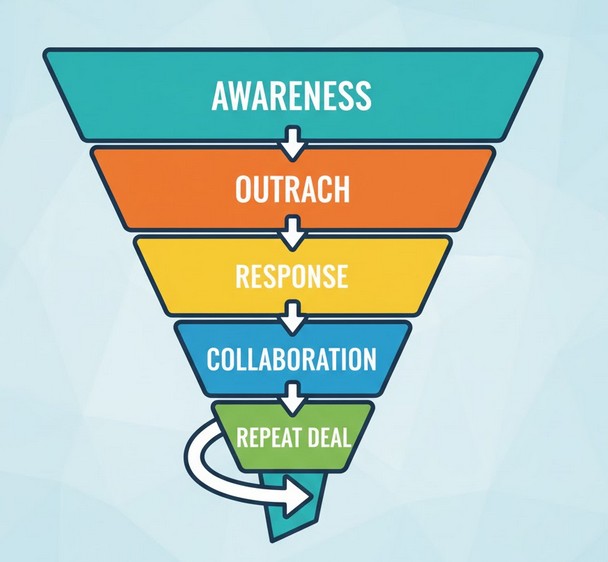
The next step is finding the right partners not just any local business, but ones whose audiences overlap with yours.
Here’s how to identify the right fit:
1. Define your photography niche
Before reaching out, get clear on your niche.
Ask yourself:
- What type of clients do I want (weddings, portraits, food, fashion, real estate)?
- What businesses do these clients already visit or trust?
For example:
- Wedding photographers: Florists, event planners, makeup artists, dress boutiques, jewelers, and venues.
- Food photographers: Restaurants, cafés, bakeries, catering companies, food bloggers.
- Portrait photographers: Salons, gyms, personal trainers, co-working spaces.
- Product photographers: Local brands, artisans, eCommerce stores, gift shops.
2. Create a Partner Prospect List
Use a simple Google Sheet to list potential partners with columns for:
- Business name
- Owner or manager contact info
- Instagram / website link
- Audience overlap score (1–10)
- Partnership idea (e.g., “joint Instagram giveaway,” “in-store display,” “free photo day”)
Start with 20–30 local businesses in your area. You can find them through:
- Google Maps (“boutique near me,” “salon near me”)
- Instagram local hashtags (#DhakaSalon, #SingaporeCafe, #NYCWeddingVendor)
- Local business directories
- Networking events or markets
3. Qualify them
Don’t partner with everyone. Look for:
- Businesses with good branding (you don’t want your name tied to low-quality visuals)
- Active social media presence (they’ll promote you too)
- Audience alignment (their clients are your ideal clients)
Tip: Always check engagement. A café with 2,000 loyal followers beats one with 20,000 bots.
Step 3: Define Your Value Proposition (What’s in It for Them?)
Here’s the secret to getting “yes” from local businesses make it about them, not you.
Most photographers pitch like this:
“Hey, I’d love to collaborate! I can take great photos for your shop.”
That’s not a value proposition, that’s a request.
Instead, show how partnering with you directly benefits their business. Here are a few win-win examples:
| Partnership Type | What They Get | What You Get |
|---|---|---|
| Co-marketing Campaign | Free branded photos for their marketing | Exposure via their channels |
| Barter Deal | Free mini-shoots in exchange for promoting your services | New audience reach |
| Paid Partnership | Discounted package for recurring shoots | Steady income & referrals |
| Event Collaboration | Professional coverage of their event | Access to attendees & tagging |
| Giveaway Collab | Free photo session as part of giveaway | Follower growth & visibility |
Pro Tip: Phrase your offer like this:
“I noticed your cafe’s Instagram is vibrant, but some images don’t match your brand vibe. I’d love to shoot a small content set for you — no charge. In exchange, we can tag each other and I’ll feature your café in my next local business spotlight series.”
That’s irresistible. You’re helping them first.
Step 4: Prepare Your Pitch Assets
Before you send a single email or DM, make sure you have a few essential assets ready. This preparation instantly sets you apart from amateurs.
1. Partnership One-Pager
A concise, well-designed PDF that includes:
- Who you are
- What you offer
- How the collaboration works
- Benefits for the business
- Sample deliverables (e.g., “10 professional images + cross-promotion”)
- Contact info and social links
It should look clean and professional — one page max.
[Insert Placeholder: “Download Sample Partnership One-Pager”]
2. Mini Portfolio or Case Study
Show proof of results. A quick “before and after” or short success story adds credibility.
Example:
“Here’s a florist I partnered with. Their Instagram engagement grew 2.5x after our photo shoot and they booked two new wedding clients.”
3. Pricing Sheet or Offer Menu
Keep it flexible. You can include:
- Paid options (discounted rate for recurring shoots)
- Barter options (exchange for exposure or product value)
- Hybrid options (partial payment + mutual promotion)
4. Social Proof
Collect testimonials, brand logos of past clients, or short quotes.
Example:
“Natasha captured our restaurant’s menu perfectly. We use his photos on every ad.”
— Café Bloom, New York
These simple additions make your pitch irresistible.
Step 5: Craft an Irresistible Outreach Message
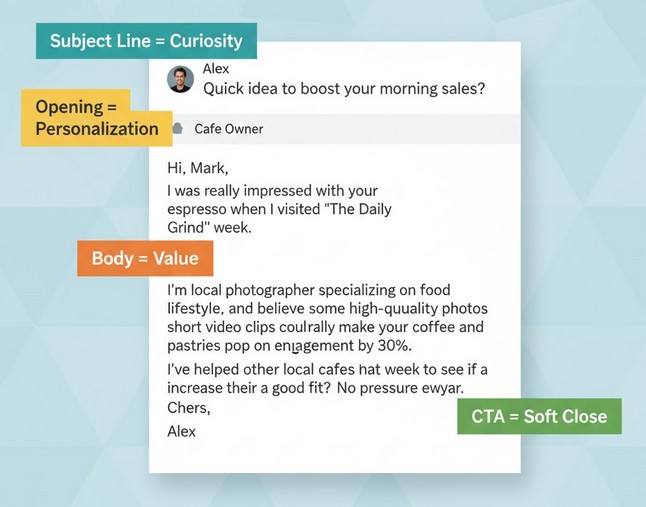
Now that your assets are ready, it’s time to reach out.
Here’s where most photographers fail. They either send generic copy-paste DMs or long, desperate paragraphs.
What works best is a short, tailored, benefit-first message.
Here’s advice: Personalization + Clarity + Reciprocity.
Sample Email Template #1 — Cold Intro
Subject: Love your brand — quick collab idea
Hey [First Name],
I’m a local photographer here in [City] and love what you’re doing with [Business Name].
I had an idea that could help both of us. I could shoot a few free branded images for your store or Instagram, and we can tag and cross-promote each other.
No pressure! just thought it could be a fun way to get new content for your socials and spotlight your brand in my portfolio.
Would you be open to a quick chat about it?
— [Your Name]
[Website / Instagram]
Keep it under 100 words. Personalize each one.
Follow-Up Tip
If you don’t get a reply in 3–4 days, send a polite follow-up like:
“Hey [Name], just wanted to circle back — I’d still love to collaborate when you’re ready. Even one mini-shoot could be great for your socials.”
Step 6: Follow Up (Without Being Annoying)
Most partnerships aren’t lost because someone says “no”. They’re lost because you never follow up.
An research on outreach shows that over 60% of positive responses come after the second or third email. That means polite persistence is your secret weapon.
Here’s a simple follow-up framework that works beautifully for photographers:
Follow-Up Timeline
- Day 1: Initial email (short and friendly)
- Day 3: Quick reminder (1–2 lines)
- Day 7: Offer value (e.g., “Here’s a free sample photo idea for your Instagram”)
- Day 14: Final polite message (soft close)
Follow-Up Template #2 — Value-Add Message
Subject: Free idea for [Business Name] visuals
Hey [First Name],
I know things can get busy! I mocked up a quick idea that could fit your feed — showcasing [specific theme].
Here’s one I shot recently that got great engagement: [insert link or attachment].
Would love to create something similar for you. Think it could help boost your engagement this month.
Cheers,
[Your Name]
This type of follow-up shows effort and relevance — two key trust signals for local business owners.
Pro Tip: If they still don’t respond, leave the door open. Message again in a month with a fresh idea or campaign concept. The goal is long-term relationship building, not one-off deals.
Step 7: Negotiate Clear Terms and Deliverables
Once you have interest, it’s time to set boundaries kindly, clearly, and professionally. Nothing ruins a good partnership faster than vague expectations.
What to Define in Every Partnership:
- Scope of work: What exactly are you providing? (e.g., 15 edited photos, one-hour shoot, two reels)
- Timeline: When will you deliver, and when will they post or promote?
- Usage rights: Can they use your images in ads? For how long?
- Credit & tagging: How will they mention or tag you on social?
- Compensation: Cash, barter, or hybrid?
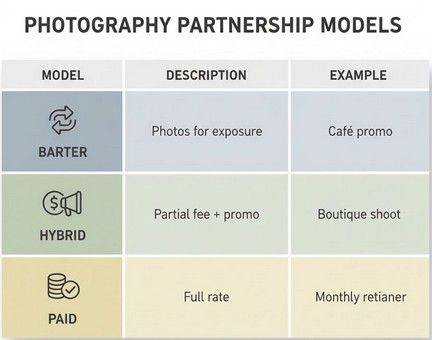
Partnership Types (with examples)
| Model | Description | Example |
|---|---|---|
| Barter | You exchange services (photos for exposure, meals, products, etc.) | Café provides meals + tags your page for every post |
| Hybrid | Reduced fee + promotion commitment | Boutique pays $100 and posts twice a week for a month |
| Paid | Full professional rate with cross-promotion | Local gym books you monthly for $300 + shoutouts |
Pro Tip: Always put it in writing even for free deals. A simple, one-page Partnership Agreement prevents confusion.
Template: Partnership Agreement (Short Version)
Parties: [Photographer Name] (“Photographer”) and [Business Name] (“Partner”)
Purpose: To collaborate on a photography project for marketing and promotional purposes.
Deliverables: Photographer will provide [number] edited photos by [date].
Usage: Partner may use the images for [platforms or time period].
Credit: Partner agrees to tag or credit Photographer in each relevant post.
Compensation: [State barter, partial payment, or full fee].
Duration: [Date range].
Signatures: ____________________________
[Insert Placeholder: Download Partnership Contract Template]
Having this ready makes you look like a serious professional and it helps protect your work legally.
Step 8: Plan and Execute a Co-Marketing Campaign
Once the deal is in place, make the partnership visible.
This is where you turn one shoot into dozens of impressions, leads, and backlinks.
What is Co-Marketing?
Co-marketing means both partners promote the same content for mutual gain. Your photos become marketing fuel for both sides.
For example:
- You photograph a cafe’s seasonal menu.
- They post the photos on Instagram and tag you.
- You post a behind-the-scenes reel tagging them.
- Together, you run a small “photo day” giveaway for followers.
Each post exposes you to their audience, creating exponential visibility.
Checklist: Simple Co-Marketing Workflow
- Plan posts: Decide who posts what, and when.
- Design visuals: Use Canva templates for joint stories or announcements.
- Create hashtags: e.g., #CapturedBy[YourName] #LocalBusinessSpotlight
- Run a mini-contest: “Win a free photo session + $50 gift card from [Partner].”
- Cross-tag everything: Tag partner on all images, stories, and reels.
Example
A lifestyle photographer in Singapore partnered with a fashion boutique. They ran a “Local Style Week” campaign — the photographer shot the store’s new arrivals, and both accounts posted daily reels. Within 10 days, the boutique gained 800 new followers, and the photographer booked four new clients.
The partnership didn’t cost a cent, but delivered thousands in exposure value.
Step 9: Measure Results and Optimize
One thing that sets Backlinko-style marketers apart is that they measure everything.
If you can show a business how much their engagement or sales improved, you’ll earn repeat deals and stronger referrals.
Metrics to Track
| Metric | What It Shows | How to Track |
|---|---|---|
| Website Traffic | Did your partner drive new visits? | Google Analytics or GA4 |
| Leads / Inquiries | Are people booking sessions from this collab? | Track inquiry source |
| Social Growth | How many new followers did each side gain? | Instagram Insights |
| Engagement Rate | Which type of posts performed best? | Likes/comments ratio |
| Revenue or ROI | Did it lead to bookings or sales? | Compare pre/post campaign data |
Create a simple spreadsheet and share highlights with your partner.
This transparency builds massive trust.
Pro Tip: Create a Case Study After Every Collaboration
Turn your best partnerships into marketing gold.
Here’s how:
- Document results: before/after stats, screenshots, testimonials.
- Write a mini-story: “How we increased [Partner Name]’s engagement by 250% using professional photography.”
- Publish it on your blog.
- Send it to local business directories or magazines.
- Share it on LinkedIn and tag your partner.
Backlinko does this constantly — transforming every win into content that ranks and attracts backlinks.
Your future partners will see these stories and think:
“I want those results too.”
Step 10: Nurture and Scale Your Partnerships
Think long-term. The biggest mistake photographers make is treating partnerships like one-off campaigns.
Instead, focus on turning great collaborations into recurring monthly deals.
How to Keep Partners Engaged
- Monthly check-ins: Send updates or seasonal photo ideas.
- Surprise extras: Gift a free image set or behind-the-scenes reel occasionally.
- Feature them: Create a “Local Business of the Month” highlight on your page.
- Refer them too: Reciprocity builds loyalty — send them clients when possible.
Example Workflow
Every quarter, pick three of your best-performing partnerships. Offer them a “Seasonal Refresh Package” — 15 new photos + 1 short reel at a loyal partner rate.
If each partner brings just 2 new clients per month, and you have 5 partners, that’s 10 extra bookings — with no ad spend at all.
When to Scale Up
Once you’ve mastered 3–5 partnerships:
- Replicate your system in nearby towns or neighborhoods.
- Hire an assistant or junior photographer to manage shoots.
- Use your case studies to pitch larger local brands or chains.
Each new partnership becomes a referral engine that keeps compounding your exposure and income.
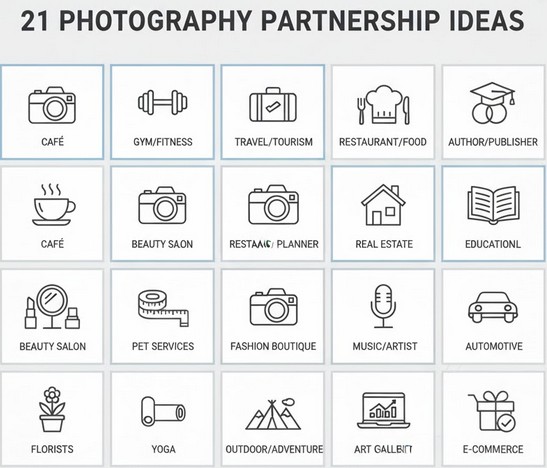
Bonus: 21 Creative Local Business Partnership Ideas
Want inspiration? Here are 21 proven partnership ideas that photographers use to grow fast:
- Free mini-sessions at a salon’s “open day.”
- Food shoot for a café’s new menu.
- Seasonal giveaway with a boutique.
- Cross-promo with a fitness trainer (“before and after” transformations).
- Free photo booth setup at a local event.
- Partner with wedding planners for styled shoots.
- Collaboration with florists for product photos.
- Co-branded wall prints for cafés or hotels.
- Feature a small business in your “local heroes” blog series.
- Run a workshop for local brands on “how to create better visuals.”
- Team up with a gym for member headshots.
- Photoshoot package for Airbnb hosts.
- Partner with a school or university for graduation portraits.
- Offer brand photography for local artisans.
- Shoot social content for restaurants’ delivery menus.
- Build a referral network with wedding vendors.
- Cross-promote with influencers who shop local.
- “Photographer of the Month” feature in a mall.
- Charity shoot with NGOs (massive goodwill).
- “Local Business Portrait” LinkedIn campaign.
- Coffee-table collaboration: your photos displayed in stores.
Each of these ideas is searchable, linkable, and re-postable — perfect for organic reach and backlinks.
FAQ: Questions About Partnering With Local Businesses
1. How do photographers collaborate with local businesses?
Start by identifying businesses whose customers match your ideal clients. Then offer something valuable — like a free mini-shoot, professional photos for their marketing, or a joint giveaway. Send a short, personalized outreach email (under 100 words), and always focus on what’s in it for them.
Once you get a “yes,” create a simple written agreement outlining deliverables, credits, and timelines.
2. What are the best local businesses for photography partnerships?
It depends on your niche:
- Wedding photographers: florists, makeup artists, dress boutiques, jewelry stores, event planners, venues.
- Food photographers: restaurants, cafés, bakeries, caterers.
- Portrait photographers: gyms, salons, co-working spaces, personal branding coaches.
- Product photographers: local makers, eCommerce boutiques, furniture stores.
Focus on businesses that already have good branding and active social accounts. They’re more likely to value quality visuals — and to tag you.
3. Should I charge or offer free work at first?
Early on, barter deals are powerful — they help you build case studies and real local exposure.
However, the goal is to convert those into paid partnerships. After two or three successful collaborations, start introducing hybrid models (discounted rate + cross-promotion).
Rule of thumb: offer free work only if the exposure is measurable — e.g., a partner with an engaged audience or proven local reach.
4. How do I protect my photos in a collaboration?
Always use a partnership agreement that defines:
- Who owns the copyright (you should retain it).
- How long the partner can use the photos.
- Required credit (tag or mention).
- Usage limits (social only, or ads too?).
If you’re in doubt, use a lightweight Creative Commons license or watermark early previews before final delivery.
5. How do I find the right person to contact?
For small businesses, message the owner directly via Instagram or the “Contact” form on their website.
For medium-sized companies, find the marketing manager or brand director. Tools like Hunter.io or LinkedIn Sales Navigator can help you locate verified emails.
Use the person’s first name and mention something specific about their brand — personalization dramatically increases your reply rate.
6. How do I handle rejection or no response?
Expect a “no” or silence from about 60–70% of your outreach — it’s normal.
If they say “not now,” add them to a follow-up list. Reach out again after 6–8 weeks with a new idea.
Even better: engage with their posts regularly in the meantime. When they see your name pop up consistently, your next message feels more natural.
7. How do I track partnership ROI?
Track three main metrics:
- Traffic: visits to your website or profile via partner mentions.
- Leads: inquiries or bookings tagged as “from [Partner Name].”
- Engagement: social growth or shares.
Use Google Analytics, UTM tracking links, or simple spreadsheets. Over time, this data will show which partnerships bring the best returns — and which to double down on.
8. What if a business uses my photos without permission?
Send a polite but firm message first.
Example:
“Hi [Name], I noticed some of my images on your feed. I’m thrilled you liked them! Since we didn’t have a usage agreement for this campaign, could we discuss proper credit or licensing options?”
If they ignore you, watermark future images, and avoid future deals with them. Most local businesses will comply when you remain professional.
Local SEO Optimization for Photographers: How to Get Found by Partners
One of the hidden gems of Backlinko-style strategy is stacking content SEO + local SEO.
Even if you have the perfect partnerships, they’re worthless if potential collaborators can’t find you.
Here’s how to dominate your local search results for “photographer near me” and “brand photography [city].”
1. Optimize Your Google Business Profile (GBP)
- Claim your profile and verify your address.
- Use a keyword-optimized business name (e.g., “Moshiur Photography — Branding & Portraits in Dhaka”).
- Upload high-quality images (show both work and behind-the-scenes shots).
- Add all relevant categories (“Portrait Photographer,” “Commercial Photographer,” “Event Photographer”).
- Encourage reviews after every project — especially from business partners.
Pro Tip: Add photos of your collaborations to your GBP. This gives social proof and SEO power.
2. Build Local Citations
List your business consistently (same name, address, phone number) across:
- Facebook Page
- Yelp / Foursquare / Local directories
- Chamber of Commerce site
- Local wedding or vendor directories
- Niche-specific listings (e.g., restaurant or fashion guides)
Backlinko recommends creating a citation checklist to ensure consistency.
3. Use Local Keywords in Your Content
Instead of just saying “photography partnerships,” say:
- “photography collaborations in Singapore”
- “how to partner with Dhaka cafés for photography”
- “local business photoshoots in West Bengal”
These longtail location-specific phrases help you rank in localized searches and map packs.
4. Build Local Backlinks Through Partnerships
Each time you partner with a business, ask for a backlink on their website or blog.
For example:
“If you post our collaboration on your site, could you link my portfolio page as photo credit?”
Even a few of these links can dramatically improve your Domain Authority and local ranking.
Backlinko’s studies consistently show that high-quality local backlinks are among the strongest ranking factors for service businesses.
5. Showcase Case Studies on Your Website
Create a dedicated “Local Partnerships” page.
For each collaboration, include:
- Business name & niche
- 3–5 sample images
- Summary of goals & results (e.g., “+45% engagement”)
- Testimonial quote
- Call-to-action (e.g., “Want to collaborate? Contact me here.”)
Each case study acts as an SEO magnet — full of natural LSI keywords like “local brand photoshoot,” “vendor collaboration,” and “co-marketing photography.”
6. Internal Link Your Ecosystem
Interlink this pillar post to:
- “Photography Email Templates” (resource post)
- “Local SEO for Photographers” (supporting post)
- “Case Study: How I Tripled My Bookings Through Partnerships” (authority post)
This cluster signals topical expertise to Google — a core Backlinko strategy known as “Content Hubs.”
7. Keep Updating and Re-Promoting
Google loves freshness. Every 6–12 months:
- Add 1–2 new case studies.
- Update your email templates with new versions.
- Embed short videos (reels, testimonials, behind-the-scenes).
- Share it again on your social channels and tag partners.
Each update re-signals relevance to search engines, helping you maintain a #1 ranking over time.
Conversion Optimization: Turning Readers Into Leads
You don’t just want traffic — you want bookings.
At the end of the post, include lead magnets that turn curious readers into warm leads.
Suggested Lead Magnets
- Downloadable ZIP Bundle: 7 Outreach Email Templates + 1 Contract + 1 One-Pager.
- Free 15-Minute Consultation: Offer a local business audit call.
- Email Course: “5 Days to Build Your First Local Business Partnership.”
Each one builds your email list and positions you as the go-to expert photographer in your area.
Optimized CTA Example (Backlinko-style)
Ready to Partner with Local Businesses and Grow Fast?
Get my free “Local Partnership Starter Kit” — 7 proven outreach templates, 1 contract sample, and a real case study you can copy.[Download the Kit Now]
Make sure the CTA button uses a contrasting color and appears:
- After the intro
- Mid-article (after Step 5 or 6)
- At the end of the article
Three CTAs per long-form post = ideal balance between visibility and user experience.
Psychological Triggers That Boost Conversion
- Specificity: “10-step system,” “7 templates” — exact numbers build trust.
- Proof: include small case-study screenshots.
- Reciprocity: give free value before asking for contact info.
- Scarcity: limit the number of free calls (“only 10 per month”).
These micro-optimizations help turn an SEO article into a client-generating asset.
Pro Tip for Outreach
After someone downloads your free templates, send a thank-you email sequence:
- Day 1: Thank-you + link to templates.
- Day 3: Bonus tip on local partnership ideas.
- Day 5: Case study link.
- Day 7: Offer a free consultation or portfolio review.
That’s exactly how Backlinko nurtures readers into paying clients.

