If you’re a photographer in 2025, here’s the reality: having talent isn’t enough anymore.
The photography industry is more competitive than ever. According to a recent Statista report, the number of professional photographers worldwide is expected to surpass 4.3 million by 2025. And yet, a large portion of them struggle to land consistent clients.
The problem? Most photographers rely on word-of-mouth or Instagram posts without a real marketing plan in place. That means inconsistent bookings, unpredictable income, and difficulty scaling a photography business.
The solution? A step-by-step photography marketing strategy designed for 2025.
In this guide, you’ll learn:
- Why every photographer needs a solid marketing plan this year.
- A proven 8-step framework to attract more clients.
- How to use SEO, social media, email, and AI tools to stand out.
- A complete photography marketing checklist for 2025.
Let’s dive in.
Why Need a Marketing Plan for Photographers in 2025
The photography industry is growing, but so is competition. According to IBISWorld, the U.S. photography market is worth $16.2 billion in 2025, with over 240,000 professionals. Which means clients have more options than ever.
Here’s why a defined marketing strategy is critical in 2025:
AI-driven search is changing discovery
Tools like ChatGPT, Perplexity, and Google’s AI Overviews pull from websites with strong SEO. If you’re not optimized, you won’t show up.
Local SEO dominates bookings
More than 46% of all Google searches are local (Think with Google). Brides, families, and businesses aren’t browsing hashtags. They’re searching “photographer near me.”
Social media saturation
Instagram, TikTok, and YouTube Shorts are where clients hang out. Without a content plan, you’re invisible to most of your potential audience.
Photography is oversaturated.
Whether you shoot weddings, portraits, or commercial gigs, thousands of competitors exist in every city. A marketing plan helps you differentiate.
Bottom line: a strong marketing plan is as important as a strong portfolio. You need a multi-channel, system-driven strategy.
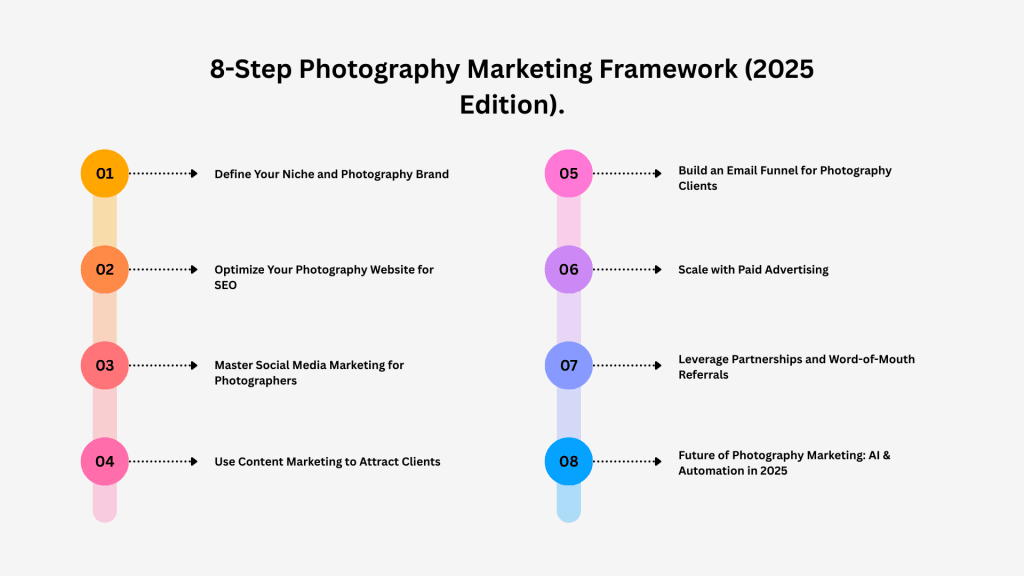
Step 1 – Define Your Niche and Photography Brand
Before you worry about SEO, social media, or ads, you need to answer this question:
“What makes me different from every other photographer in my city?”
That’s where niche + brand positioning come in.
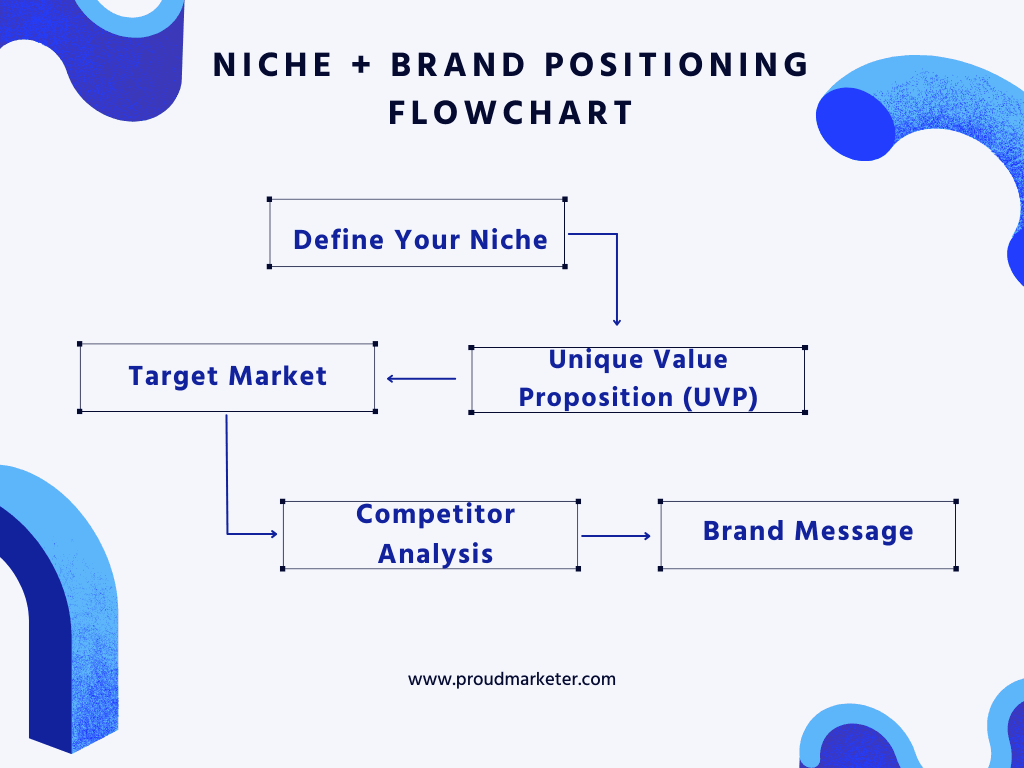
Pick a Profitable Niche
Not all photography niches are created equal. Some have much higher demand and profitability in 2025. For example:
- Wedding Photography → high-ticket packages, steady demand.
- Portrait & Lifestyle Photography → consistent bookings from families and individuals.
- Commercial & Branding Photography → businesses need constant visuals for marketing.
- Product Photography → e-commerce is booming, fueling demand.
- Real Estate Photography → realtors and Airbnb hosts rely on eye-catching visuals.
Pro Tip: Instead of trying to be a “jack of all trades,” specialize in 1–2 niches and market yourself as the go-to expert.
Build a Strong Value Proposition
Your value proposition answers: “Why should clients choose me over someone else?”
Examples:
- “I help couples relive their wedding day through cinematic, documentary-style photos.”
- “I create bold, scroll-stopping product photography that helps e-commerce brands sell more.”
This clarity makes your marketing message powerful and consistent.
Real Example
A Toronto-based photographer shifted from general work to specializing in brand photography for female entrepreneurs. Within 12 months, her Instagram grew to 20K followers, she landed 3x more clients, and she now charges double her old rates.
Branding + niche = marketing superpower.
Step 2 – Optimize Your Photography Website for SEO
Your website is your digital storefront. In 2025, it’s often the first impression clients have of your business.

But here’s the catch: if your site doesn’t show up in search results, clients won’t even know you exist. That’s why SEO (Search Engine Optimization) is a must.
On-Page SEO Basics
- Keyword Optimization: Use terms like “wedding photographer in [city], portrait photography packages, product photographer 2025” naturally in titles, headings, and descriptions.
- Metadata: Write compelling meta descriptions for each page (this boosts click-through rates).
- Alt Text: Every photo in your portfolio should have descriptive alt text (Google can’t “see” images without it).
Local SEO for Photographers
Most clients search locally. Here’s how to dominate:
- Create or claim your Google Business Profile.
- Add location-specific keywords: “best portrait photographer in Chicago”.
- Collect 5-star Google reviews from happy clients.
- Embed a Google Map on your contact page.
Portfolio Optimization
Your portfolio isn’t just about showcasing your best shots — it needs to convert visitors into clients.
- Make it mobile-friendly (70%+ of clients browse on phones).
- Organize by niche (weddings, portraits, commercial).
- Add captions telling the story behind each shoot (boosts engagement + SEO).
- Include clear CTAs like “Book Your Session” or “Check Availability.”
Example in Action
A New York wedding photographer optimized their site for “Wedding Photographer New York” and wrote blog posts like “Top 10 Wedding Venues in New York.” Within 6 months, they ranked on page 1 of Google and started booking 10+ weddings/month.
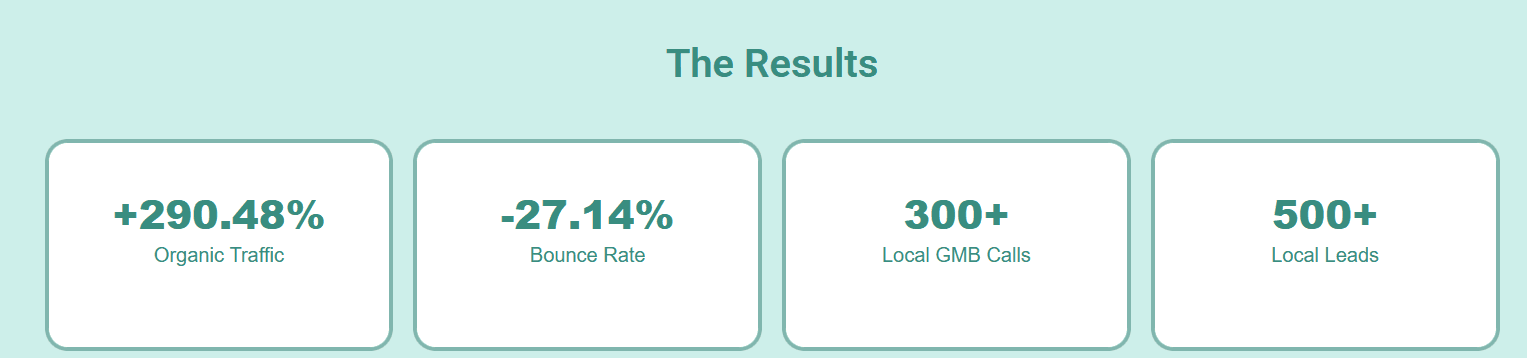
That’s the power of SEO.
Step 3 – Master Social Media Marketing for Photographers
Social media is no longer optional. It’s where most photographers get discovered in 2025.
But here’s the truth: posting pretty photos isn’t enough.
You need a system.
Focus on Platforms That Matter in 2025
- Instagram Reels: Still a top choice for visual storytelling. Behind-the-scenes clips, before-and-after edits, and carousel posts work great.
- TikTok: Exploding for photographers. Short, entertaining tips like “How to Pose for Photos” or “Editing Hacks” go viral fast.
- YouTube Shorts: Perfect for quick tutorials and showcasing transformation edits.
- Pinterest: Underrated but powerful for wedding and lifestyle photographers (great for SEO traffic too).
What Type of Content Works Best
- Behind-the-Scenes (BTS): Show how you set up shots, pose clients, or edit.
- Transformation Posts: Before & after editing comparisons.
- Storytelling: Share client success stories.
- Tips & Tricks: Quick posing guides, lighting hacks.
- Relatable Memes: Light-hearted content that gets shared.
Pro Tip: Post Less, Repurpose More
Instead of trying to post daily, create one high-quality shoot, then repurpose it across platforms:
- Turn a BTS video into an Instagram Reel.
- Expand it into a TikTok tutorial.
- Use stills for a Pinterest board.
- Write a blog post to boost SEO.
Case Study
A photographer Dhir Jakharia gained 150,000 followers in under three months by posting engaging Reels, demonstrating the potential of this strategy.
That’s the compounding power of social media done right.
Step 4 – Use Content Marketing to Attract Clients
If SEO is about being found and social media is about being seen, content marketing is about building trust.
When potential clients see your name repeatedly across blog posts, videos, and guides, they start to view you as the expert. And in 2025, trust is the #1 factor in booking decisions.

Blogging for Photographers
Blogging might sound outdated, but it’s still a goldmine for SEO and lead generation. Why? Because Google loves fresh, relevant content.
Blog topics that perform well:
- “Best Wedding Photography Locations in [City]”
- “How to Prepare for a Professional Headshot Session”
- “The Ultimate Guide to Product Photography for Small Businesses”
- “10 Outfit Ideas for Family Photoshoots”
These posts target long-tail keywords, attract local traffic, and position you as an authority.
Guest Posting & Collaborations
Don’t just write for your own site. Partner with:
- Wedding planners (guest post on their blogs).
- Event venues (offer styled shoot photos for their sites).
- Lifestyle bloggers (collaborate on photo guides).
This builds backlinks (SEO gold) and gets your work in front of new audiences.
Video Marketing in 2025
YouTube remains the second-largest search engine in the world. Smart photographers use it to:
- Post BTS vlogs of client shoots.
- Share quick editing tutorials.
- Compare gear and setups.
Example: A California-based commercial photographer launched a YouTube channel focused on product photography lighting hacks. Within a year, he hit 50K subscribers — and now 60% of his clients discover him through YouTube.
Repurposing = More Reach, Less Effort
Every photoshoot can fuel multiple pieces of content:
- Blog post with images.
- Instagram carousel with the story.
- TikTok “behind-the-scenes” video.
- YouTube tutorial breaking down the lighting.
- Email newsletter highlighting the shoot.
This creates a content flywheel — one shoot equals 5+ marketing touchpoints.
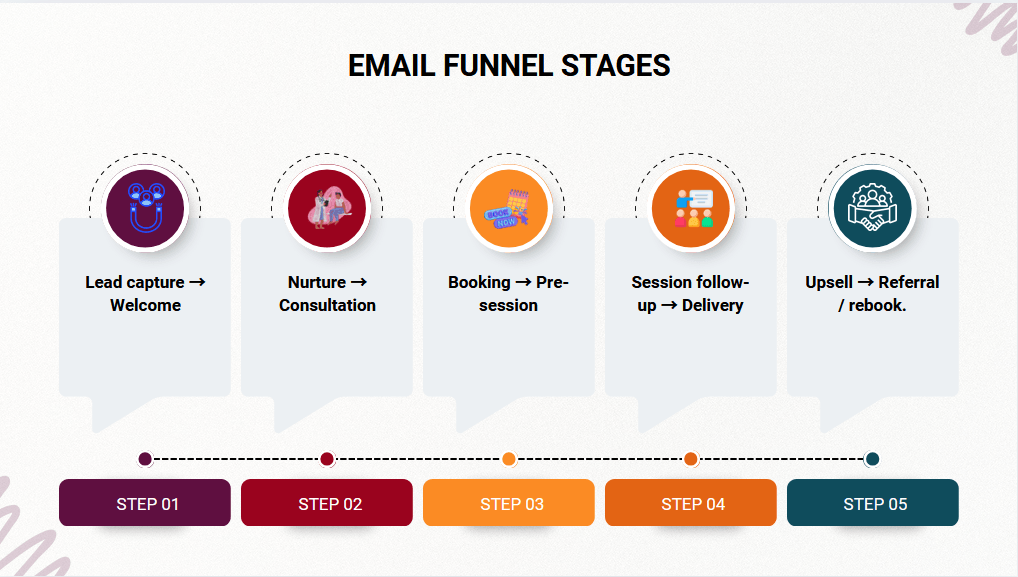
Step 5 – Build an Email Funnel for Photography Clients
Here’s a hard truth: social media followers don’t belong to you.
If Instagram shuts down tomorrow, you lose your audience. But an email list? That’s 100% yours. And in 2025, email is still one of the highest-ROI marketing channels for photographers.
Why Email Works
- Direct connection: You’re not competing with social media algorithms.
- Personalization: Send tailored offers (weddings vs portraits vs commercial).
- Automation: Once set up, your funnel runs on autopilot.
Step 1 – Create a Lead Magnet
Give people a reason to join your email list. Example ideas:
- “The Ultimate Engagement Photoshoot Checklist”
- “What to Wear for Your Family Photoshoot” (free PDF)
- “Top 10 Wedding Venues in [City] with Photo Examples”
Offer the lead magnet in exchange for their email address.
Step 2 – Build an Automated Sequence
- Welcome Email: Share your story, portfolio, and why you shoot.
- Value Email: Provide tips (posing, locations, styling).
- Trust Email: Showcase testimonials and success stories.
- Offer Email: Promote a package or limited-time discount.
Step 3 – Keep Nurturing
Don’t just email when you want a booking. Share helpful guides, behind-the-scenes stories, or even seasonal promotions like:
- “Now booking fall mini sessions”
- “Valentine’s couples shoots available”
Example: An award-winning studio used email newsletters featuring past wedding images and tips, generating ten bookings in its first launch week.
Step 6 – Scale with Paid Advertising
Once your organic marketing is running smoothly, paid ads can help you scale faster.
But here’s the key: don’t throw money at ads without a strategy. In 2025, platforms are more competitive, and costs are higher. That means targeting and tracking are critical.
Facebook & Instagram Ads
Still the #1 channel for photographers running paid campaigns.
- Target life events like “recently engaged.”
- Run ads showing your best wedding shoots.
- Use carousel ads with “before and after” editing.
Google Ads
Perfect for high-intent searches.
- Keywords like “portrait photographer near me” or “product photographer in New York.”
- Run ads with clear CTAs: “Book Your Shoot Today.”
- Add local targeting for max efficiency.
Retargeting Ads
Most clients don’t book after their first visit to your site. Retargeting keeps you top of mind.
- Show ads to people who visited your portfolio but didn’t inquire.
- Remind them with testimonials or time-sensitive offers.
Budget & ROI
Start small ($200–$500/month) and scale what works. Always track results:
- Cost per click (CPC).
- Cost per lead (CPL).
- Cost per booked client (CAC).
Example: For instance, a wedding photographer achieved $8,000 in business from a $200 Facebook ad spend, resulting in a 40x return on investment Medium.
Step 7 – Leverage Partnerships and Word-of-Mouth Referrals
Even in 2025, some of the best marketing is still human-to-human.
Local Partnerships
- Wedding planners & venues: Offer free photos of their events in exchange for referrals.
- Event organizers: Become their go-to photographer.
- Fashion boutiques: Partner on lookbooks and cross-promotions.
Referrals from Clients
Your happy clients are your best marketing assets. Encourage referrals with:
- Discounts on future shoots.
- Free prints or bonus photo sessions.
- Simple: If you refer a friend who books, you get $100 off your next session.
Online Reviews = Social Proof
Google reviews, Yelp testimonials, and even Facebook recommendations matter. A 2024 survey showed that 92% of clients read online reviews before booking a photographer.
Ask for reviews right after delivering photos — when the excitement is highest.
Step 8 – Future of Photography Marketing: AI & Automation in 2025
This is where things get exciting. AI is reshaping the photography industry — not just in editing, but also in marketing.
AI Editing & Client Previews
- AI tools like Imagen AI or Luminar Neo now cut editing time in half.
- Some platforms allow clients to preview different editing styles before delivery.
AI in Marketing
- AI-powered captions: Tools generate Instagram captions in your brand’s voice.
- Client segmentation: AI helps you identify which clients are most likely to book again.
- Predictive ads: Ads optimized by AI for best performance.
Automation = More Time Shooting
By automating repetitive marketing tasks (emails, social scheduling, ad optimization), photographers can spend less time glued to screens and more time doing what they love: shooting.
Photography Marketing: AI vs. Automation Comparison Table
Category | AI (Artificial Intelligence) | Automation |
|---|---|---|
Definition | Simulates human intelligence to make decisions and predictions. | Executes predefined tasks or workflows without human intervention. |
Examples in Photography | – AI-driven photo tagging | – Email scheduling |
Personalization | High – Uses data to personalize content based on behavior or preferences. | Moderate – Can personalize using set variables (e.g., name, location). |
Tools | – Adobe Sensei | – Zapier |
Use in Client Experience | Smart chatbots, auto image curation, AI-driven recommendations | Appointment reminders, email drip campaigns, feedback forms |
Content Creation | Can write captions, blogs, and emails; generate content ideas | Posts or emails are sent at the right time but not created automatically |
Analytics & Insights | Predictive analytics, customer behavior modeling | Basic performance tracking (open rates, click-through rates, etc.) |
Learning Capability | Yes – Learns and improves over time based on data | No – Follows static rules or schedules |
Setup Complexity | Higher – Needs training, data integration, and tuning | Lower – Typically involves drag-and-drop setup or templates |
Scalability | Highly scalable with intelligent adjustments | Scalable but static; needs manual updates for changes |
Best Use Cases | – Image recognition | – Scheduling posts |
Limitations | – Can be expensive | – Rigid rules |
Step 9 – Photography Marketing Strategy Checklist (2025 Edition)
At this point, you’ve learned a complete 8-step framework to market your photography business in 2025. But let’s be real: it’s a lot to take in.
That’s why I’ve created a Photography Marketing Strategy Checklist you can use to make sure nothing slips through the cracks.
Branding & Niche
- Identify your photography niche (weddings, portraits, commercial, product, real estate).
- Write a clear value proposition that sets you apart.
- Develop a consistent brand style (visuals, tone, editing).
Website & SEO
- Optimize your website with target keywords.
- Add metadata, alt text, and fast-loading images.
- Create a Google Business Profile for local SEO.
- Collect 5+ client reviews on Google.
- Write 2–4 blog posts per month targeting local long-tail keywords.
Social Media Marketing
- Choose 2–3 core platforms (Instagram, TikTok, YouTube Shorts, Pinterest).
- Post at least 3x/week with a mix of BTS, storytelling, and tips.
- Repurpose every shoot into multiple content formats.
- Track engagement analytics monthly.
Content Marketing
- Blog at least once a month with SEO-focused posts.
- Collaborate with wedding planners, venues, or bloggers.
- Upload at least 1 YouTube video or tutorial monthly.
- Repurpose blog + video content into social snippets.
Email Marketing
- Create a lead magnet (checklist, guide, or template).
- Build an automated 4–6 email nurture sequence.
- Segment your email list by niche (weddings, portraits, commercial).
- Send seasonal promotions (mini sessions, holiday offers).
Paid Ads
- Start with a $200–$500/month test budget.
- Run Facebook/Instagram ads targeting life events.
- Test Google Ads for high-intent keywords.
- Set up retargeting for site visitors.
Partnerships & Referrals
- Reach out to 5+ potential partners (planners, venues, boutiques).
- Launch a referral program for clients.
- Ask every client for an online review post-shoot.
AI & Automation
- Use AI tools for editing (e.g., Imagen AI, Luminar).
- Automate email marketing & social scheduling.
- Test AI copy tools for captions and ad copy.
Conclusion: Build a Photography Marketing System, Not Just Random Posts
Here’s the big takeaway:
Most photographers treat marketing like an afterthought. They post a few pictures on Instagram, hope for word-of-mouth, and cross their fingers that clients will roll in.
But in 2025, that approach doesn’t cut it.
The photographers who win are the ones who treat marketing like a system:
- They niche down and brand themselves clearly.
- They optimize their online presence for search.
- They show up consistently on the right social platforms.
- They capture leads through content and email funnels.
- They scale with ads, partnerships, and AI automation.
This system doesn’t just bring clients in the short term — it builds long-term stability.
So, here’s your challenge: pick one strategy from this guide and implement it this week.
It could be as simple as:
- Writing a blog post targeting best photoshoot locations in [your city].
- Posting a behind-the-scenes Reel.
- Setting up your Google Business Profile.
Small steps compound. And by the end of 2025, you’ll have a photography marketing engine that works for you 24/7.
Now it’s your turn.
Want a head start? Download the Photography Marketing Strategy Checklist (2025 Edition) and start implementing today.
FAQs (Optimized for SEO & Schema)
Q1: How do photographers get clients in 2025?
Photographers attract clients in 2025 by combining SEO, social media (Instagram, TikTok, YouTube Shorts), and content marketing. Building an email funnel, running paid ads, and leveraging referrals also play a major role.
Q2: What’s the best social media platform for photographers in 2025?
Instagram remains the most popular for photographers, but TikTok and YouTube Shorts are exploding in reach. Pinterest is powerful for wedding and lifestyle niches. The best platform is where your target clients spend the most time.
Q3: Do photographers still need a website in 2025?
Yes. Social media is important, but your website is your digital home base. It improves SEO, builds trust, and converts visitors into clients. Without a website, you risk looking unprofessional and losing leads.
Q4: How much should photographers spend on marketing?
Most photographers start with $200–$500/month on paid ads. Organic strategies like SEO, blogging, and partnerships are low-cost but require consistency. As revenue grows, aim to reinvest 10–20% into marketing.
Q5: How can photographers use AI for marketing?
AI helps photographers by automating editing, generating captions, analyzing client behavior, and optimizing ads. Tools like ChatGPT, Jasper, and AI-powered schedulers save time and improve results.
Final Thoughts
Marketing your photography business in 2025 isn’t about chasing every trend. It’s about building a system that consistently attracts clients, nurtures them, and converts them into long-term fans.
Follow the strategies in this guide, use the checklist, and stay consistent. Your portfolio shows your talent, but your marketing strategy will decide how many people see it.